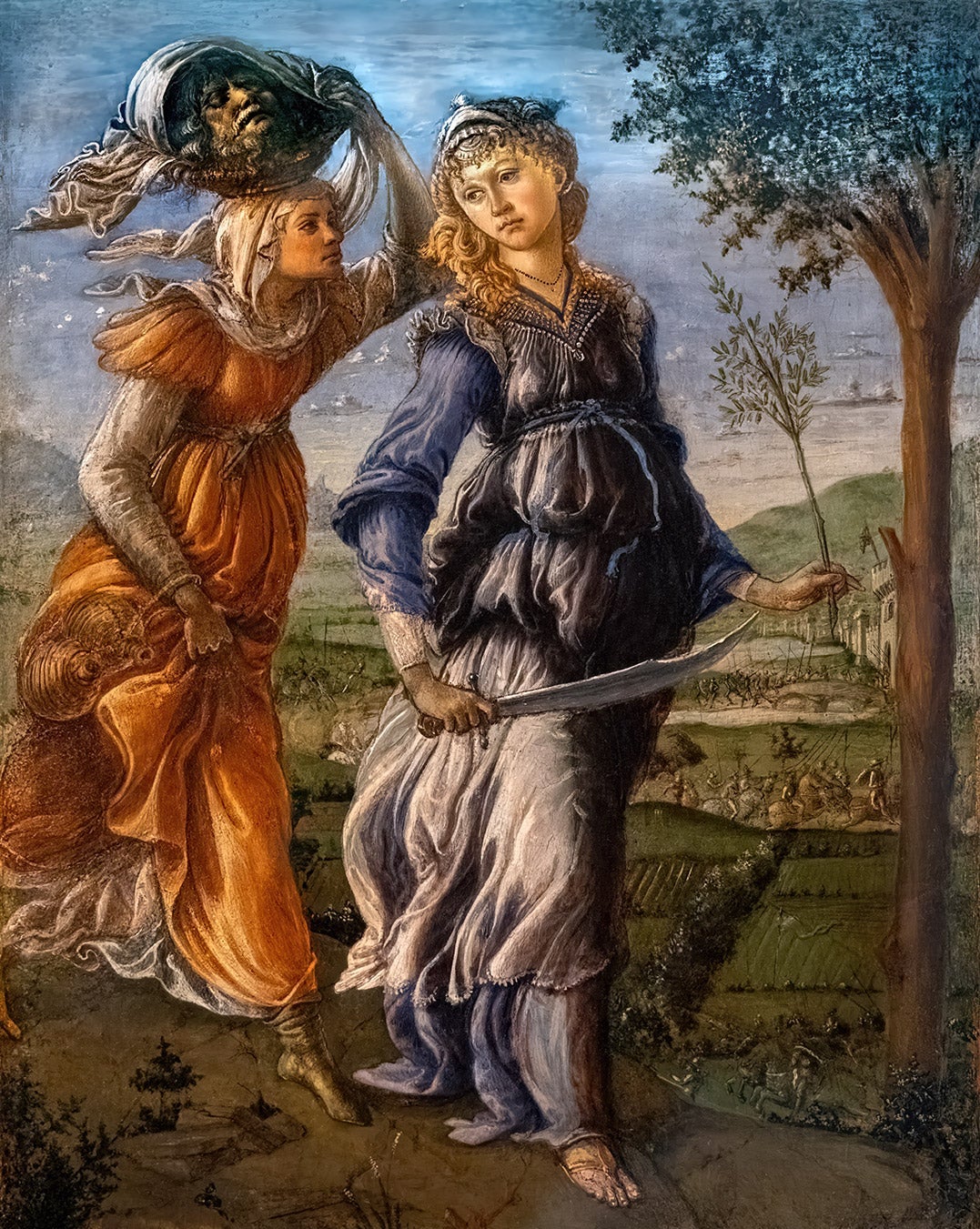
The Return of Judith to Bethulia, Sandro Botticelli, 1472, Uffizi Gallery, Florence. Judith, the beautiful widow with a golden heart, the anti-witch par excellence: just as Jesus redeems the worst instrument of torture by transforming it into the eternal source of salvation for all, the Cross, so Judith “straightens“ and redirects the figure of the “witch“, bringing her back toward God. She is a symbol of Mary and of the Church, because she crushes the head of the serpent that hunts God's people, with God's help, preserving her purity. Just as Jesus becomes “sin“, though innocent, Judith makes herself a “witch“, while remaining chaste, to save Israel: while the Israelite city of Bethulia is under siege by a king who wants to dominate everything, she accepts God's dangerous mission and is led right into the enemy camp. After a series of cunning tricks and calculated seductions, she manages to be brought into the tent of the enemy leader, Holofernes, after having gotten him completely “drunk“ on her. Instead of “dying“, it is death itself that is defeated: Judith, asking God for strength, severs Holofernes' head, using his own curved sword, coming out inviolate and victorious. If once, in the intimacy of her Prince, the witch sells off her body to seduce and lead him astray, Judith does the opposite: she “cleanses“ the tent of evil and restores peace. In the painting, Judith advances with an olive branch in her hand, while her faithful servant keeps the severed head in her bag, where she had earlier stowed the Israelite food to “starve“ the enemy. Holofernes' severed head is hung atop the walls of Bethulia, and in a way analogous to the Cross placed atop our bell towers —or the pole raised high by Moses—, the severed head restores vigor and courage to the frightened people of God, while the enemy flees in panic before the wonder it has witnessed.
Witches are very easy to spot: they are the ones who make the male's seed go to waste1. Many men don't think about it; they find themselves effeminate or childless2 and they don't quite know how it happened: it is their own fault, for they are stupid, and the witches', who keep them in check, under their spell. They don't think about it, but when they look at witches on the screens of their cellphones to arouse themselves, their seed ends up going straight into the garbage, or down the drain, right next to their own urine and excrement. That is the place where witches want to put the seed of their men: as low as possible, at the bottom of the garbage. They don't think about it, but when the witches give up their body to them, always half naked, shaved to make them still look like little girls3, drugged up to make them sterile, or with instruments in their body to redirect the seed of their male elsewhere, far from their bodies, the male's seed ends up, one way or another, always there: in the garbage, in the sea, or in some other lowly place. This is what a witch wants to do with your seed: she throws it away.
Abortion4 is obviously the witches' favorite ritual. There is no murder more congenial to witches than that of the unborn, because it fully expresses their power over their male, which is all they care about5. To crush the seed that was sown, to treat it like waste, to display their invincibility, and to lay bare the definitive impotence of their male. "You can do nothing", "I'll kill it for you anyway". And if the poor thing even manages to be born, the sadism is redirected against the little one: the witch knows very well how to win him over with kisses and lollipops, in a house made of sweets and toys, like the one of Hansel and Gretel; then she puts a little skirt on him and parades him around like a little girl, with the risk that he even comes to believe he is one.
There is no greater humiliation than getting their male to even say "well done, witch", "kill my child, scatter my seed", "you are a witch, you are powerful, I can do nothing against you". The defeated male, totally humiliated and sterile, a medal on the chest for any self-respecting witch. The male who nurses the babies, who goes around with the sling and pushes the stroller, there is no greater triumph to carry in procession, for the more vain witches. Even more flattering, if that male is glad to be treated like a pet, to be a kangaroo mommy in front of everyone. "I love my witch so very much". When a male says this, it is a clear S.O.S. signal, it should actually be interpreted as a desperate call for help.
Fortunately, real witches with hats and brooms in hand are not yet to be seen going about, for now we just carry them in our minds6, but that does not prevent them from doing a great deal of damage anyway. The falling birth rate of Western countries can be traced entirely to two actors: lustful males seduced by voracious witches. Abortion and contraceptives have made millions of people go missing from the count7, literally thrown into the trash. Is there a way out? Yes, a magic word that spins the heads of witches around 360 degreesvideo and completely dries up the jaws of wolvesvideo: chastity. To be chaste. A practice increasingly forbidden in our countries, where sodomy, that is, the undignified squandering of our bodies, seems to have to be safeguarded at all costs8. Chastity is bothersome, because it holds up families, raises up solid nations, glorifies long marriages between man and woman, while there is an easy and effective way to destroy all of this: not to be chaste, not to love oneself and others.
To be chaste is to safeguard one's own dignity, the dignity of one's own body and the dignity of one's own person, it is not to die while alive, and it is to live love in fullness9. It is self-control, discipline, attention, care: it is putting things in the right place so as not to waste even a drop, not a single moment, not a single feeling, a sensation. It is wanting the most, aspiring to the best, giving meaning to things and not settling for bland, colorless, dull, fleeting stories. It is obviously a continuous challenge, for all of us. A dream of beauty, but one that is possible, if cultivated together, in communion, trust and mutual respect.
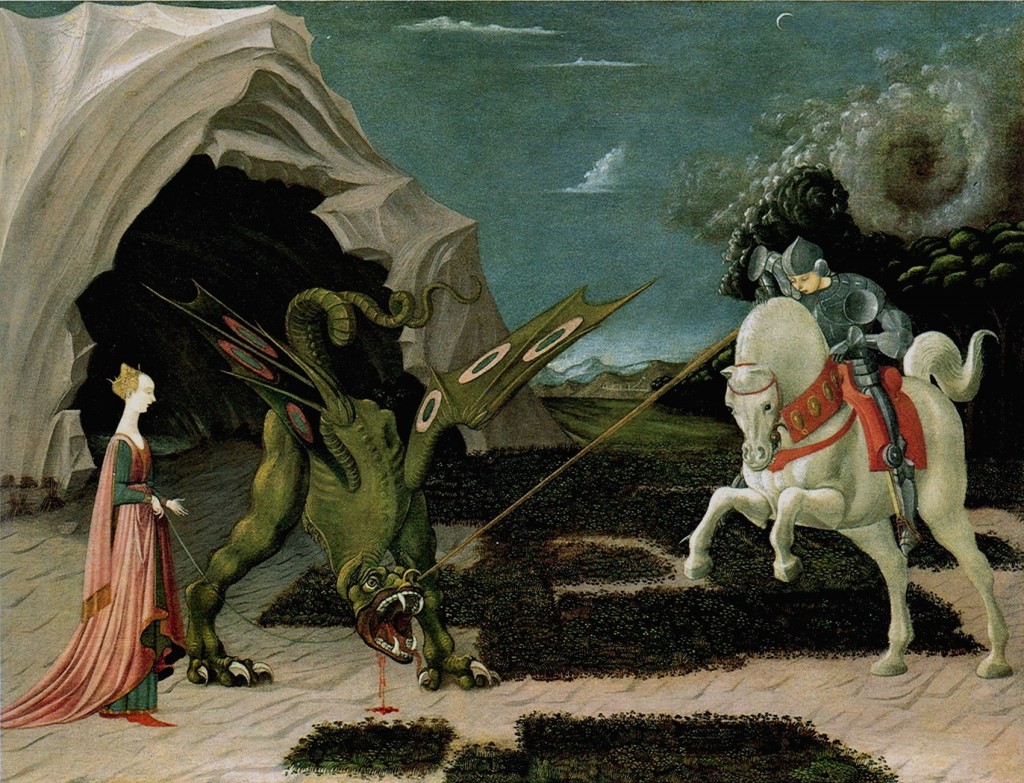
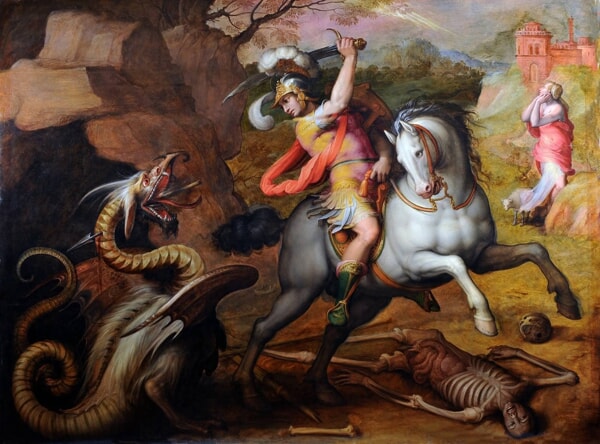
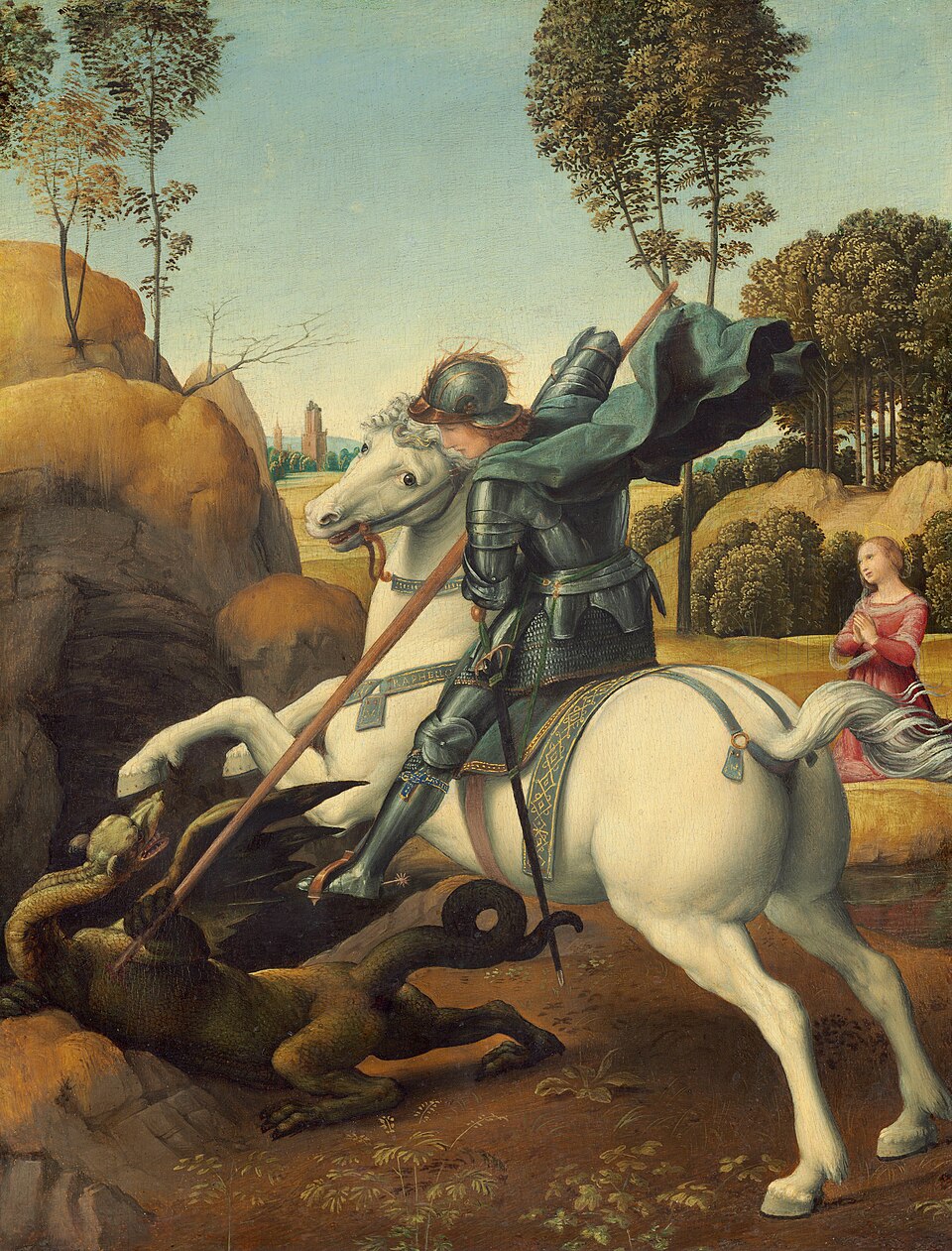
Saint George and the Dragon. The story of Saint George, a Roman soldier and martyr of the first centuries after Christ, blends myths and legends, but it matters little what this dragon concretely was10, its symbolism is true and eternal. The representations vary, but the constant figures are always the same: the innocent princess, often paired with a pure white lamb, in the act of prayer or literally led in chains by the dragon; Saint George on his white horse piercing the dragon with a lance, running it through the palate, the heart, or often both in a single blow, or ready to sever its throat with a sword. In a representation by Stradano (or Vasari), the story is enriched by a detail: the dragon's endless hunger is kept at bay first with sheep, then with citizens, then at the end with the king's daughter.
In the Book of Revelation, Saint John represents Satan as a dragon: a voracious and ambiguous animal, half bird that flies in the sky, half serpent that crawls on the ground; the perfect incarnation of Lucifer, the fallen angel, condemned forever to eat dust by God. He hates Mary and hunts her, and with her he hates the Church and humanity, still unable to grasp how God, creator of All, can bring such respect and attention to his humblest creatures, made of mortal and fragile bodies, unwise, always so fallible11. Lucifer, fully taken with himself, has in fact given up knowing what true Love is.
Nothing makes a witch melt in the sun, nothing slowly burns away all her wicked plans like a good male. A savior. He simply does not fit into their plans. He must not exist. If there is a savior, at least let it be a woman12. But a male, no. And yet Jesus is male. "Ecce homo": the first Man, the new Adam! On the cross he is naked and he is male before everyone. Faced with the mockery and jeers of all, he is male and gives himself entirely for his Bride. We cover him out of modesty, certainly not to raise doubts in the witches about who saves and who is saved. Jesus saves his Church, and so he teaches us true Love. We learn it and then try to explain it and to put it into practice in our lives.
Without the One Savior, who is Jesus Christ, Our Lord, what remains for us is only the barbaric hunting of witches. The dark hunting season began long ago, it's called femicide. It is the dragon males who, in their thirst for ever-fresh blood, do not allow their women to be female: symbolically, they imprison the femininity of their women in some dark recess of their castles, locked in a dungeon, and in time they even forget where they put it and where the key is. But the thirst is never quenched, the sacrifices of maidens are never enough, and so they explode in great drunken bursts of fire, destroy villages, disfigure with acid, commit family massacres. Unlike what modern children's cartoons want us to believe13: with a dragon you do not make peace, you do not coexist, you do not train it to be docile and cute like a kitten, you do not keep it on your shoulder. No one can afford a dragon in the house. The dragon is to be killed, you take the lance and strike it straight to the heart14. It is the heart you must aim for, the heart. The dragon's blood then heals every wound.
Let it not be taken literally, to aim for the heart means full conversion: it does not mean keeping it at bay, lulling it to sleep for a while, narcotizing it, not talking about it, pretending nothing is wrong, making it your friend. No, it means death and resurrection. Metanoia: complete redirection, of its thirst, of its strength, of its mind, toward God, toward the good, toward peace, toward love among people. You should not recognize it. You will have to hear it said, "Where is my old dragon? Where is my son?". Then you will know that someone has truly died and risen again, has finally become himself.
The heart is in fact the home of the will: it is there that the saying "I will no longer be a dragon", "I will no longer be a witch" is born, there is a choice, an act of will, inviolable, because totally free, untouchable, even by God, but necessary, indeed indispensable, to end the hunting of witches, to end the swarming of the too many dragons roaming free in our cities.
Saint Michael the Archangel, defend us against the wickedness and snares of the devil. With the Power that comes to you from God, you, Prince of the Heavenly hosts, chain in hell Satan and all the evil spirits who roam through the world seeking the corruption of our souls. Amen.
Our mind goes immediately to the seed tied to the male sex —in fact, nowadays that is the easiest one to monitor in order to spot witches—, but the definition can be applied symbolically to anything that holds within itself, in a small space, a great potential, a simple encoded piece of information, a center that informs, orders or enriches the world. God promises Adam that from his seed a great nation will descend, which will bless all the nations of the earth. Jesus will be that seed (Galatians 2:16), who dies to produce much fruit (John 12:24); his words are like seeds that settle in our hearts to produce good fruit (the parable of the sower, Luke 8). Who, then, is the witch? She is the bird that, in the parable, comes down from the sky, seizes the seed and devours it. As Jesus himself explains, the bird is actually the devil, who carries away the word from our hearts and makes them barren. The witch indeed is not recognized mainly by how many seeds the male casts, but by how much fruit they yield, because if she is a witch, there is no fruit: everything is squandered, ruined, time and energy are lost for little or nothing.
In popular traditions, the witch does as those birds described by Jesus: she flies in the sky on a broom and swoops down to earth to snatch and “sweep away“ newborn children (the child is the first sprout of a future adult, one that has already cost their parents so much; the witch's broom is the perfect symbol of the bad “cleaning“, or of efficiency at all costs, that sweeps away even the good things). Other typical seeds stolen by witches are: money (the classic witch-wife who seduces for the pleasure of using her rich husband's credit card); children (another unfortunate episode, of witches who drive husbands to divorce in order to seize and squander his children; this is a recurring pattern in many traditional stories, where the stepmother always pushes the father to abandon the children in some unpleasant place, like a forest, the desert or on a cliff); the head (the head fits perfectly into the pattern of the seed, not only for its shape, but because it stores encoded information and uses it to give orders to the body; a classic result of a witch's attack is a male who goes out of his head, does senseless things, makes rash decisions and loses everything; the pattern is found in many traditional stories concerning sailors seduced by the sweet song of the sirens, who end up drowned, stranded or with their boat destroyed).
In the story of Snow White, the “little“ men are well represented by the dwarves, each excessive in some dimension, none a match for the poor unmarried maiden. The disappearance of masculine traits and the feminization of a society appears in Exodus in a paradigmatic way. Pharaoh, wishing to weaken God's people, gives the order to kill all the male sons of the Hebrews, increasing the female proportion of the population. This drives Moses' mother to abandon him in a river, to save him. As often happens in the biblical accounts, and continues to happen even today (see Judith like Joan of Arc, but there is even an echo in Mary, where Joseph is almost about to abandon her, before being stopped by an angel), when the male leaders show reticence or cowardice, or lose authority, it is the female or marginal character who saves the situation. The plan in fact backfires on Pharaoh: Moses ends up in the hands of Pharaoh's daughter, who raises him as her own son; it will then be he who leads the Hebrews toward the liberation from Egypt, while God's last plague will cause the death of Egypt's own firstborn males, including Pharaoh's grandson. In the same way, in the story of Judith, it is Holofernes' greed, his wanting to dominate and subjugate everyone to himself, that is his true weak point, exploited by an Israelite woman who gives herself to him, only to then kill him. Obviously it all reappears in the Calvary of Jesus: a “slave“ bound to the cross will save the world from death, the women and the most “gentle“ apostle will be the only ones to remain faithful to him; the women, again, will be the first witnesses of his Resurrection, while the apostles are locked in the house, frightened. In this there is nothing revolutionary; the aim is not to invert the roles but to restore them (see 5); it is the greatest mockery played against death: to be defeated by a God who becomes man, born of a woman, who dies, resurrects and brings glory back to the Father; this is still true for us today, humble humans, when we defeat the “invincible“ sin thanks to the gift of the Holy Spirit, revealing His power.
The infantilization of women is a recent phenomenon observed in post-Christian societies, where the woman is no longer a mother, but prey and subjugated (the same society that progressively does not know how to see anything wrong in polygamy and in marriage with minors, imported from the East). Even the most reticent are beginning to be horrified by a certain Western pop culture: for example, the many singers, loved and followed by millions of young girls, ever more uninhibited in performing on stage dressed as dolls or little girlslink,link, while they wink at the audience. These same ones are then perhaps great champions of abortionlink, or they are the same ones who hand out abortion pills on the sidelines of their concertslink. The outfit choices may perhaps be unintentional, but surely less so are the choices of the girls who sell themselves to do-it-yourself online pornography, or those of the directors who cast them, always “sold“ with little-girl voices, clumsy carelessness, totally hairless bodies and full submission to the will of their butcher.
About abortion
The witch is revolutionary, and for this reason she is so dear to the feminist movement, which, masked by its Orwellian name, has as its true objective, and among its greatest historical successes, the elimination of femininity in women. To make them “manly“, because the male is no longer seen as equal and complementary to the woman, but as the highest standard of perfection, the supreme prototype to which all must aspire. The definitive victory of feminism is the trans woman: the woman priest, the woman who cuts off her breasts, the woman who cuts her hair and becomes a theologian, or head of state.
Femininity in the Bible is the opposite of this. The genius of the female, when it comes into play, is not to subvert the roles but to reestablish the very same order, when it has come to be lacking. She is anti-revolutionary. The mother of Moses and Pharaoh's daughter save the Hebrews when they are totally subjugated to a foreign enemy, leading to their freedom and elevating Moses as their new leader. Judith intervenes in the face of the cowardice of the Israelite leaders; her words and her actions restore confidence and courage to those same leaders. Mary makes herself the “ark“ of God to bring her Son into the world, when the Hebrew spiritual leaders are completely corrupt, making Joseph a courageous husband and the apostles the first cornerstones of his Holy Church. An even clearer episode: Mary Magdalene and the other women, the only ones who had not lost devotion and faith in Jesus, go to visit the tomb and thus become the first witnesses of Christ's resurrection; meanwhile his disciples are locked in the house, disheartened and frightened. The women do not exploit the situation to elevate themselves, but follow the order given by the angel: they go to the apostles to announce the miracle and to strengthen in them the faith in the true Messiah. The symbolism is not limited to the sexes: Saint John the Baptist, the first announcer of Christ, a figure “on the margins“, alone in the desert, did not exploit his gained popularity, instead, as instructed by an angel, he made himself small to point to the true Messiah (John 3:30). Jesus will call him the greatest among the prophets (Luke 7:28).
Witches do not exist, or at least they exist as Santa Claus exists: just as children's parents “imitate“ Santa Claus, in an analogous way some women (an even some men…) decide to imitate the behaviors typical of witches; behind Santa Claus there is a saint, Saint Nicholas of Bari, while behind the witches there hide demons. Despite the fact that more and more neo-pagan para-feminist groups identify as “witches“link, organize rituals and “cast“ curses, their idols are false and their potions useless. It is not, in fact, the “witches“ who have power over the supernatural, nor least of all their herb concoctions, as they believe and make us believe, but rather demons who deceive them and use them as pawns for their own personal ends. The effects of their curses may seem real, because people can truly suffer, but one must go to a good priest to be freed from them, not drink magic potions or follow other strange rituals: the author of the pain is a demon, and we who listen to it, not the “magic“. Magic and witches are in fact branded by the Church as superstition and divination, like horoscopes, the Chinese Ching and the ouija: they are not “pure fantasy“, there is often something more than the rational, but it is never we who play or are in control, rather it is we who are being played.
This precise position matured by the Church managed to limit to a minimum the hunting of witcheslink in Catholic countries, during its spread in the countries with a Protestant majority (Germany, Austria, Switzerland, Scotland), right after Luther's “reformation“. The lack of a central authority, a do-it-yourself theology and a rampant fear of the devil gave rise to burnings devoid of sentences or reasonable accusations. This still happens today, in countries where paganism is still very active, and often the unfortunate women find refuge in Christian missionslink.
But it is also the surprising result of the advance of materialism, or of a certain kind of animism, which thinks, for example, that it can defeat “anger“ by killing all the angry people, when “anger“ lives in the heavens, it is an evil spirit to be “killed“ in the heart and in the mind. The Catholic Church too has learned over the centuries to remain ever more faithful to the idea that the best method for fighting heresies is to “kill“ them at the root, in their false reasonings and their wrong conclusions, not in the people who profess them (see the trial of Galileo Galilei and Giordano Bruno). «For our battle is not against creatures made of blood and flesh, but against the Principalities and the Powers, against the rulers of this world of darkness, against the spirits of evil that dwell in the celestial regions» (Ephesians 6:12).
Finally, there exist no powers independent of and superior to that of God, even the powers of demons are “concessions“: in Exodus, the tricks of the Egyptian magicians manage to replicate the first three plagues —the staff turned into a serpent, the water of the Nile turned into blood, the invasion of frogs—, but they give up in the face of the fourth plague, that of the dust turned into gnats. «This is the finger of God» declares Pharaoh (Exodus 8:19). In the book of Job, the concession is even more explicit: Satan issues the challenge that he can succeed in making Job's faith collapse; God grants him power "over all that he possesses", except his life (Job 1:12). After 42 long chapters, Job has lost everything, but not the love for God, which now shines in the darkness.
"Let the heathen spill theirs, on the dusty ground, God shall make them pay for each sperm that can't be found", the irony of the Monty Python of 1983 seems today prophetic and becomes the self-irony of a sexual revolution that has caused only tragedies, including chronic depopulation and sexual appetites out of control. The Easter egg of the sketch is the demon that makes its inevitable cameo, in the form of a Chinese dragon, at the end of the balletvideo. It seems fitting to restate it today: "Every sperm is sacred", indeed!
Several European countries have already put in place laws to ban the so-called “conversion therapies“, pseudo-scientific practices, widespread in both Catholic and Evangelical circles, to "cure homosexuality", even "with violent methods or ones that harm the dignity of the person"link. Unfortunately, however, the pretext of a real problem is increasingly used to deny the truth of faith of the Catholic religion, which sees sodomy as an offense against God and against creation. To have disordered sexual attractions does not in fact imply the conscious choice to yield to them (otherwise adultery would be rampant). To wish to educate the sexual appetites, in order to redirect them to the sole good of marriage and the building of families, must remain a right of every person, who in conscience and full freedom chooses to want to undertake this life, and no law should be used to place obstacles on this path.
The only “revolution“ we like is the sexual (counter) revolution of Pope John Paul II, who spoke thus to Africa in 1993: «You need to equip yourselves for the magnificent commitment of marriage and founding a family —the most important unit of the Christian community. As young Christians, you must carefully prepare to become good spouses and good parents with families of your own. Essential to preparing for marriage is your vocation to chastity. I know that young people reject hypocrisy. You want to be honest with yourselves and others. A chaste person is honest. When God created us he gave us more than one way to “speak” to each other. Besides expressing ourselves through speech, we express ourselves through our bodies. Gestures are like “words” that tell who we are. Sexual actions are “words” that reveal our hearts. The Lord wants us to use our sexuality according to his plan. He expects us to “speak” truthfully. Honest sexual “language” requires a commitment to lifelong fidelity. To give your body to another person symbolizes the total gift of yourself to that person. But if you are not married, you are admitting that you might change your mind in the future. Total self-giving would then be absent. Without the bond of marriage, sexual relations are a lie. And for Christians, marriage means sacramental marriage. Chastity —which means respecting the dignity of others because our bodies are temples of the Holy Spirit (1 Cor. 6:19)— leads you to grow in love for others and for God. It prepares you to make the “sincere gift of self” (Gaudium et Spes, 48) that is the basis of Christian marriage. More important, it teaches you to learn to love as Christ loves, laying down his life for others (Jn. 15:13). Do not be deceived by the empty words of those who ridicule chastity or your capacity for self-control. The strength of your future married love depends on the strength of your present commitment to learning true love, a chastity which includes refraining from all sexual relations outside of marriage. The sexual restraint of chastity is the only safe and virtuous way to put an end to the tragic plague of AIDS which has claimed so many young victims. Helped by God's grace in the Sacraments of Penance and the Eucharist, “be strong and of good courage” (Deut. 31:6). The Pope urges you to commit yourselves to this spiritual revolution of purity of body and heart».
To spot a dragon you must sharpen your sight: it often hides in castles, caves or submerged in baths of coins. The classic method to make it come out is to place a prey before its eyes. The scene to keep in mind is in Jurassic Park (1993)video. Often it is a woman who gives herself, in worse cases defenseless childrenvideo, or sophisticated discussions (as in The Hobbitvideo) . In life then, the dragon often reveals itself only in bed, or only behind the walls of the home, or only in the office and not at home, or only on social media. "It seemed like such a good person". The dragon, if it is a dragon, “bursts“: it passively endures in silence, and then explodes, with the risk of burning things that were not to be burned and hurting innocent people. The dragon has a passion for dead things: money not spent (Smaug), dead plants (the rose of the Beast), decaying objects or buildings, even buried ideas; on its own, it does not quite know how to bring them back to life. The dragon takes extreme care of its teeth and its claws, because when it is time to strike, it strikes —it takes less care of whom to strike and why—, when it harpoons, it does not let go of its prey —even when it ought to let go—. Its weak points are the heart and the throat: to leave it speechless, to conquer its heart. The first converted “dragon“ was precisely at the foot of the cross: Saint Longinus, the Roman centurion who pierced the heart of Jesus, helpless and “in a trap“ on the Cross, was the first to kneel before it, astounded to see life conquering death. He was the first to exclaim: «Truly this man was the Son of God!» (Mark 15:39).
The devil's envy of human beings, loved by God, is well translated into fairy tale in the story of Snow White. It in fact resembles the perfidious envy of Snow White's wicked stepmother, who, after spending a fortune touching herself up before the mirror, cannot fathom how the Prince, the christological figure of the story, can give his life for a little girl of neither skill nor standing, how she can be the most beautiful, only because she is "pure as the snow". In a post-Christian society, even Snow White is bothersome: in the latest Disney remake, even Snow White is rebellious, indomitable and revolutionary, at the cost of thus losing her original beauty, which had made so many little girls fall in love with her.
The latest gender gimmick is to want Jesus as a woman, as if indeed humanity could save itself alone, making a revolution, becoming the boss of itself. There is not much to say about this madness, apart from noting an interesting coincidence: the actress chosen to represent Jesus as female for the first time in Hollywood is the same one who plays the wicked witch in the movie “Wicked: For Good“: the witch Elphaba, the one who incites the animals to revolution against the Wizard of Oz, the dark dictator in the “modern“ novel by Frank Baum (1900). We also find in this story that unpleasant pattern of toxic love: the wicked witch falls in love with the dictator's right-hand man, the head of the armed forces whose very task is to kill her; Elphaba succeeds in her aim of sabotaging the man's marriage to Glinda, the “good“ witch (in the tale the good witch is presented as “good“ only in appearance). It ends like all witch stories: Elphaba manages to repress the male's murderous intents by seducing him and taking him to bed; after a series of unfortunate events she is “forced“ to transform him into a scarecrow, a straw puppet in eternal search of his lost brain. She is obviously presented as the “misunderstood“ modern heroine, in a film offered to teenagers all over the world.
Humans riding dragons, and vice versa, in Avatar (2009) and How To Train Your Dragon (2010)
The most famous examples referred to are the film series for young people How to Train Your Dragon (2025) and Eragon (2006), but also all those films, books and cartoons where the figure of the dragon —or that of the tyrannosaurus— is softened or made tame, instead of being fought in the open. This strange symbiosis between humans and dragons appears even in Avatarvideo, sold as a species of "horses" to get in sync with. The important thing is to always keep in mind that ontological evil is not “recoverable“, that the deception lies precisely in making us believe that sin is harmless, that one can come to terms with it, that freeing oneself from it can be postponed; Jesus instead wants to make it quite clear to us that it is always the dragon doing the riding, even when we feel we have it under control: Truly, truly, I say to you, everyone who commits sin is a slave to sin (John 8:34).
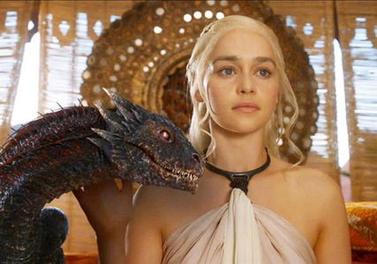
Another popular example among the more adult is in Game of Thrones, in the princess Daenerys, the lover of dragons —shown already completely nude in the first episodes of the series, so as to be sure to keep the dragons well glued to the screens—. Her first husband is an ogre, whose name is Drogo: wounded while making a show in front of her, she repays him with a “charitable“ act of euthanasia; meanwhile three little dragons are born which she always carries with her. They make her lose her head: convinced that she can bring order to the kingdom with the sheer brute force of fire, she ends up becoming the very tyrant she claimed to want to fight, massacring the innocents she had promised to free. It will be Jon Snow who stabs her in the heart, even though they had revealed themselves to be “lovers“ shortly before. The saga confirms itself as a formidable cross-section of the modern dynamics of suicidal love.
In the animated film Zootopia 2 (2022) it is directly the serpent that is painted as innocent and unjustly accused in the past. Yet in nature, in the world and in our imagination, the serpent will forever remain a serpent, which crawls on the ground, has a forked tongue, strikes us stealthily at the ankles. Just as the dragon, in order to be a dragon, spews fire without control, has claws to harpoon its prey and sharp teeth to devour it. Without these elements it is no longer a dragon, by definition. Only a post-modern mentality, where everything is an arbitrary social construct, can truly think it can totally separate the body of a character from his identity, while remaining at the same time serious (not only in cartoons, unfortunately).
Princess Daenerys and her little fire-breathing dragon (Game of Thrones)
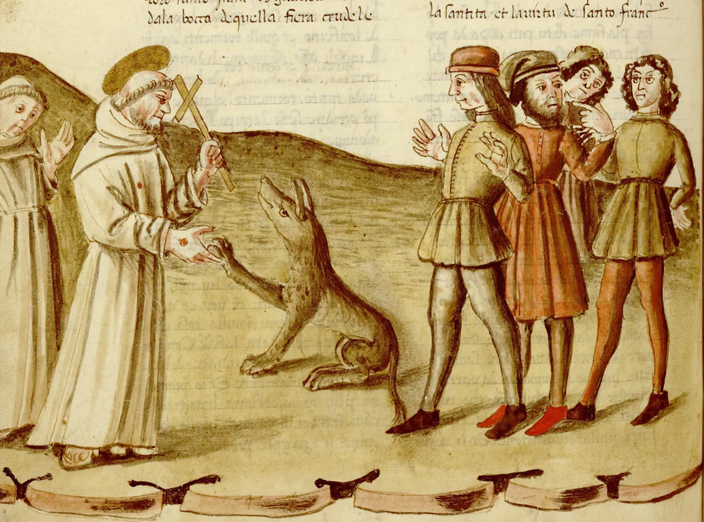
Saint Francis and the wolf: the converting power of the Cross (15th century)
The “cleaning-up“ service, or green-washing, reserved for dragons and serpents, has also been reserved for wolves: one can no longer say "death to the wolf" [which means 'good luck', in Italian], its hunger "must be understood" and accepted, it is not its fault after all, even when it devours the little girls. In the bookstores for children they have an entire section dedicated to it (direct testimony): they are then perhaps the same authors who want to foist on us the courses on affectivity in schools. "Don't worry, it doesn't bite". Then it bites and it is the fault of whoever went too close to it. The eternal fairy tale of Little Red Riding Hood reveals to us a detail as interesting as it is disturbing: the wicked wolf puts on the pink clothes of the little grandmother just devoured, so as to be able to draw the unsuspecting little girl close. This would at least explain the spread of feminine accessories, pink shirts and polos, with the little flowers and other feminine elements increasingly on the backs of males, often the least commendable ones. Between camouflage and exorcism, the advice remains to keep well away from it, or if need be to befriend a good hunter.
Ending up in the relativist grinder is also Saint Francis, painted as the “friend“ of the wolf. Although the legend that has him “sweeten“ the wolf that held the town of Gubbio doesn't revile us who or what this wolf truly wassource, it is certain that the intent has always been to explain the power of conversion, certainly not the “merits“ of the wolf. Conversion can truly change the heart of any individual, even the worst devourer of innocent little lambs; in the story, the “death“ of the wolf is equivalent to its sincere repentance for its wicked actions of the past, which manages to “kill“ and clean up its old identity; the forgiveness that reconciles us with God does not erase the truth of the sin, of the crime, which remains a crime against God's creatures and against God himself, repayable only by the extreme sacrifice of Jesus on the Cross. In the story of Beauty and the Beast, the conversion of the “wolf“ is well represented: when the “beast“ reveals his matured love for Belle, sacrificing himself for her, he is resurrected, transformed finally into the likeness of a true man. If a wolf converts, it becomes a dog at most, it cannot remain a wolf.
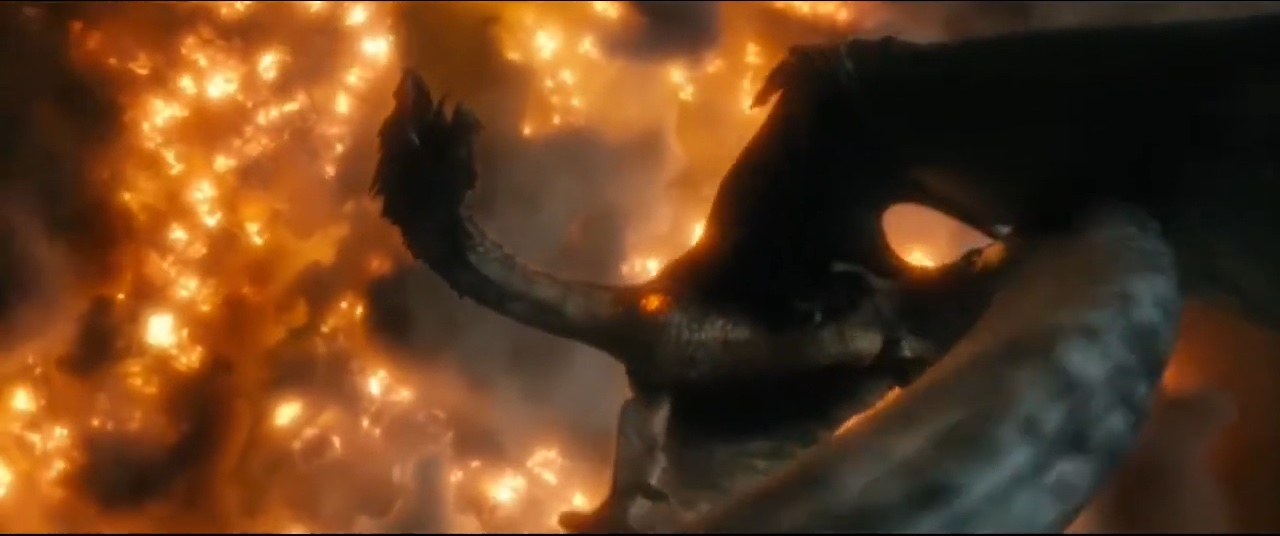
The death of Smaug in The Hobbit (2014)
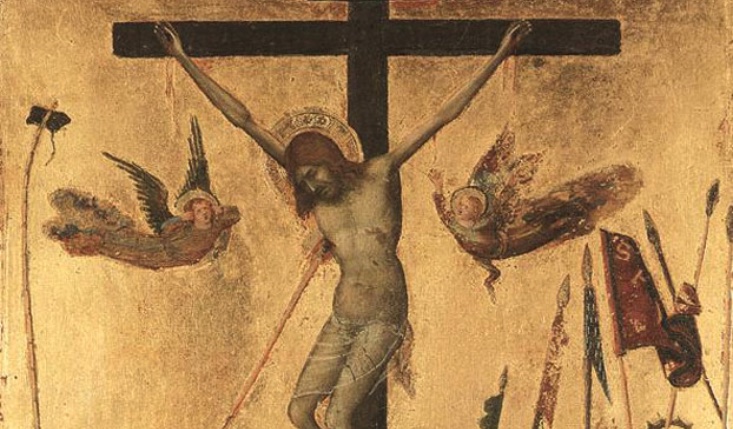
Detail of Jesus on the Cross pierced in the heart (S. Martini, 1335)
In the details the genius of Tolkien is revealed: the most famous dragon in the fantasy series is Smaug, from The Hobbit, the perfidious monster who stole the gold of the dwarves (here the “corpse“ bride of the animal is the wealth, never spent, and which therefore never bears fruit). The beast delights in rolling in its gold, so much so that it has created around itself something like an armor of metal and gems, impenetrable. The gold, however, cannot be attached in one particular spot, on the left breastbone, right there in correspondence with the heart. While Smaug shows off his riches to seduce little Bilbo, in rolling about, the hobbit notices this small detail, which will mark the dragon's death sentencevideo.
The union between man and woman, mediated by the heart, that is, by love, is at the center of two key episodes of the Bible: Eve is created in the night from a rib of Adam (according to tradition, from the left breastbone), a wound that leaves the heart itself exposed (the wound will be immediately healed by God, according to Genesis 2:21), from there follows the marriage of the two (Genesis 2:23); the act of supreme love of Jesus for his Bride, the Church, is his sacrifice on the Cross, where a Roman lance pierces his right side, arriving straight at the heart. For eternity that wound is open, in Heaven, but it is no longer a symbol of division, but rather of definitive reconciliation between God and man, between man and woman, between man and creation. The heart of God opens to the world; the blood of God, having made himself a “monster“ on the Cross, killed and then risen, is now a source of life and forgiveness for all. There is no more beautiful story.