
Everyone of us can talk about abortion. Because abortion involves a mother and a child. Some would like to give a voice only to the one who is “above”, the mother. Catholics usually prefer to give a voice to God’s favorites, those who are “below”: in this case, the children. Since all of us are children of a mother, we can all speak about abortion, that is, we can all speak about what for us is to be a Mother. For Catholics, the perfect Mother is Mary; female Saints usually are those who reflect her most faithfully; yet all of us, whenever we turn our eyes downward toward the weak and the unheard, become little “mothers”. In this sense, “motherhood” is already present in the Trinity, in the God who creates us, consoles us, never forgets us, cleans us, and nourishes us1. Everyone can talk about God; therefore, we can all talk about His absence: abortion. But before explaining why Catholics are so concerned with abortion, it is helpful to briefly clarify what the Catholic religion is.
In brief, the Catholic faith is welcoming God’s love and offering it to the world; becoming a slave for other to be slave of God, as Jesus Christ did for us on the Cross. From the outside it looks like a senseless sacrifice, a kind of madness or something extreme, but this is what we do because it gives us life: we are free and have only one Lord, yet we choose to give our lives for others3. The other foolish thing? We're happy about our Crosses, even if they're still 100% crosses: they hurt like a cross, we feel them as a cross, we do not go looking for them but we accept them, we don't like at all the hurt, we despise the suffering for itself, and the suffering is real, it hurts 100% for a Christian as for a non-Christian. The difference is that we endure it to bring glory to the One who first loved us, and give that love to the others. For us it is the most wonderful thing, the one that makes every one of our days: “bleeding” for others, as Jesus gave His blood for us4. If you get up in the morning only to get something for yourself today, and that's your goal, and that's your life, we Catholics call it “death“. That's our doctrinal definition of death5: selfishness, individualism, looking only toward yourself, what you can get out of it, what advantage we can gain from others.
We don't see children as a “curse”, we don't see them as a nice little thing you can add on top of your life, or like today something you can literally buy, like you buy a TV at the superstore, to feel fine or accomplished, to save you from boredom, to give more colour to your life, to show it around like a nice picture you took, to disseminate your semen, to exploit them for your pleasure or amusement or whatever. No. We see them as our Cross. Because they take away life from you, energy, literally food from the body of a woman, they “steal“ the money from your pockets, they take away attention, sleep, they deny our passions which build up our identity, we lose our identity because we become mom and dad, we lose ourselves. Yes, and that's the Cross. Where Jesus lost his life, his power, his identity, and all the blood from his body. But He endured it out of love for His Father and for us. Maybe there was a second when he was tempted by the Devil to give up —there were many indeed6— but he never gave up, never, because he always recalled why he was doing that: so that the Father’s will might be fulfilled, to bring love and mercy to His little children7.
And that's the other thing that seems foolish: most of his children hate him, they are the ones putting him on the Cross. We do it —we say8— every day when we sin. He gave up his life also for the children that hate him, maybe in particular for those, the lost sheep9, just out of love. A love that we don't merit. A love we can't merit10. A love so pure that it doesn't ask anything back, because God doesn't need anything back. That's Love. That's why we write it with the capital L. This is where faith comes into play, and there is nothing irrational about it: we Catholics love and venerate the Cross because Jesus truly rose from the dead. We believe that “whoever loses his life for [Jesus] will find it“ (Matthew 10:39). It is no coincidence, and it is not irrational, to observe that it is precisely children who give life to their mothers, becoming their joy and the little miracles in their lives.”
So, about abortion. Yes, catholic female saints gave up their lives to make their children be bornfig. It seems crazy and extreme to someone, but that's Love, with capital L, that's what we aspire to. And let's admit it: we all desire a mum like that, and we love and admire our mothers for that, because they gave up their lives for us and they didn't ask anything back. That looks like sanctitude for us.
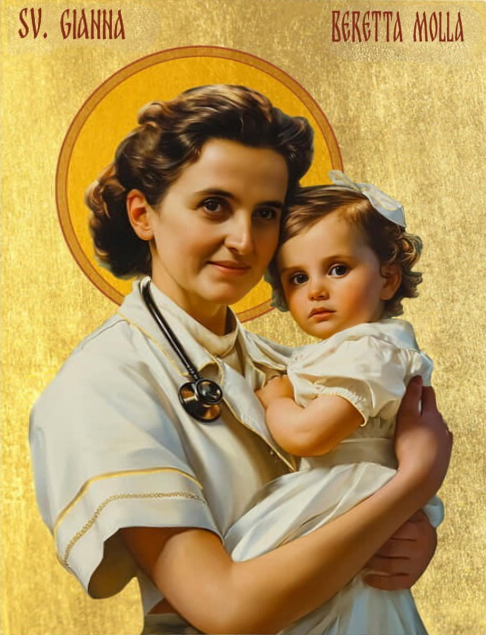
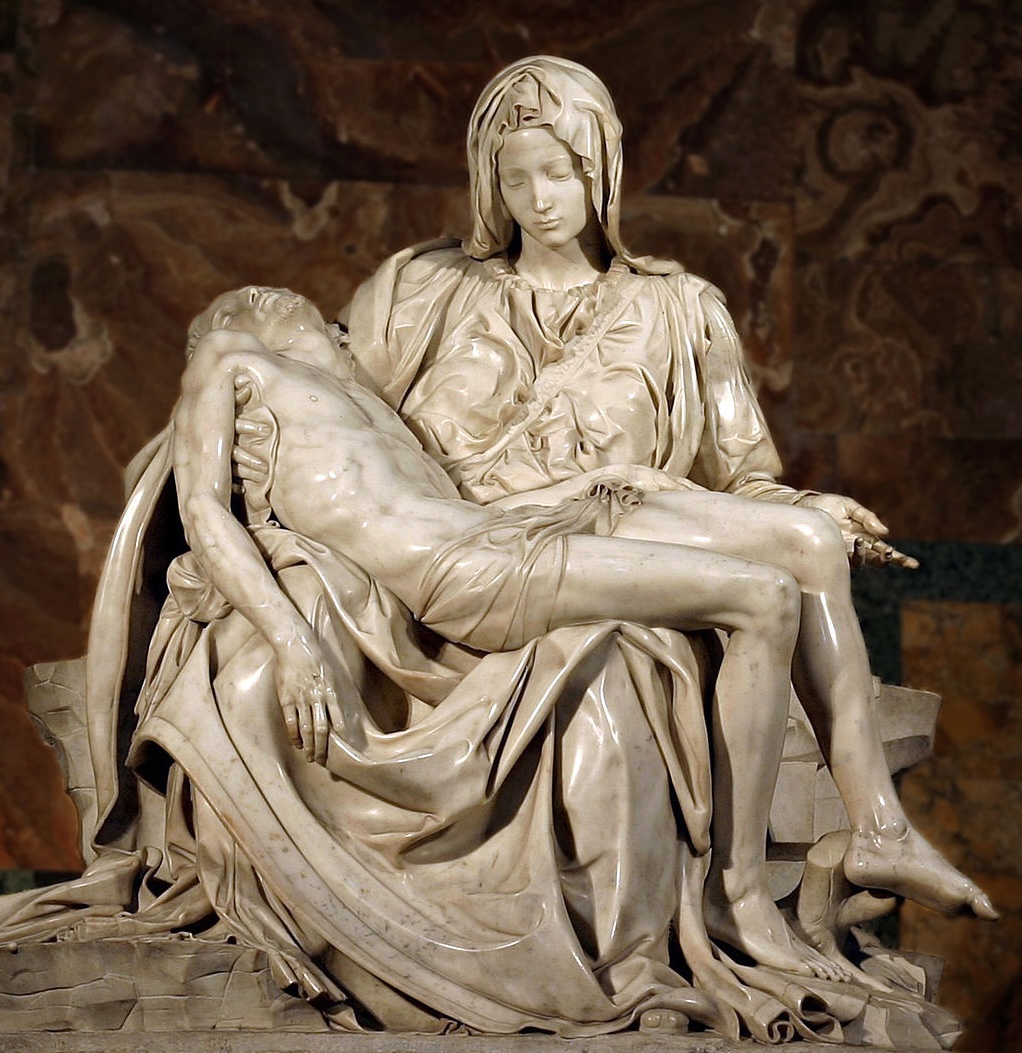
That Love is not denied even to children who were unwanted, or conceived through violence. It seems absurd at first, but there are still amazing and brave women, crazy enough for love to give up their lives for a “foreign“, an “extracomunitarian“, a child that they didn't want, didn't choose, because it's still a child. Because who your father is, doesn't define your humanity or value. You always are a little child who will love his mother and the mother will love him. A child that will boldly proclaim that violence, even the most horrendous and despicable and unjust of the violences, doesn't call for other violence in return, that the cycle of vengeance can be broken, with love and mercy11. A child that will proclaim that actually something beautiful can be born from horror, a spark of light from the scariest darkness, a blossom of hope in a sick world: a baby. That is why baby Jesus was born at Christmas12, the most grandiose Light in the darkest day of the year, and probably of history.
The love for baby Jesus is also at the core of the protection of babies in the wombs13. Jesus was already the Lord of all creation as an unborn baby in the womb of Mary. The highest made himself the lowest, the smallest, the most powerful made himself the most defenseless, dependent and vulnerable, the God who cares for all and created all made himself a creature created by a woman that asks for constant cares and attention, by humans. What an unmerited honour14! In baby Jesus there is already a shadow of the Cross: the Highest, the King, touches the lowest, the slave; at that moment humanity is united in one in Jesus Christ, through His Love, by the will of the Father. We are all one and equal in Jesus. God reaches everyone, todos, todos, todoslink: black and whites, Jews and Gentiles, men and women, no distinction in Jesus15! And if God is the highest, he should touch the lowest, which is a single human cell. If you start discussing about "how low?", "how small?", humanity is already lost. Todos, todos, todos. And humanity is lost when a down baby has practically no chance to be born with abortion16, because we still have different laws based on different DNA: down babies seat at the back of the bus17, still today, and that screams for justice.
Every human is a person. If a living being is human, then it is a person. There is no human who is not a person. Not having a functioning heart, eyes, or brain doesn't make us less human, so we're still persons, and we should always be treated as such. Therefore, we should treat babies in the womb in the same way: as persons.
Every baby teaches us what humanity really is and what's God's love. What is simplicity in the joy of life. What is hope. What are the Beatitudes18. But we kill them if we don't like them, or if they're not as we expected, because it's too much of a burden for us: we subscribed to Netflix, but the remote is not working, we should fix it or throw away everything. That's not “having children”, that's not humanity. We're called to be better human beings.
Finally, sexual acts and pleasure for catholics are a very serious thing. It's not a thing you should buy. Not a thing young uneducated people should do, not a thing to do to with a wrong partner, at a wrong time. It's potentially very dangerous, particularly for the wellbeing of the women. It's not something cheap, or casual, or violent, like a free explicit video you saw scrolling the web19. It's something serious, because it's about reciprocal and consensual Love: a Covenant of mutual respect. And the child represents that Love. It's the incarnation of that Love. It's the outpouring of that Love. It's the image of the Love between the Father and the Son that can't be contained in itself, but it outpours in a new Person, the Holy Spirit, who proceeds from both, and who's their Holy Gift for the world20. That's how serious it is for us: it's linked to the center of our doctrine, to the greatest of all the mysteries. So yes, we think sex is always procreative, it never looks at itself but it's always also a gift for others. It's not selfish. It can't be selfish. It's such a good thing that you can't keep it for yourself, you should not grasp on it and so kill it, but you are called to share it with joy and generosity, so that it multiplies21. And it needs protection and trust, it requires marriage, particularly for the most disadvantaged in the pair, who carries the biggest burden and keeps asking for more care and safe zones: the woman. In short, it's maturity, not juvenile fun.
This blog post is dedicated to all the mums, who give their life every day to their sons and daughters. And first of all, to the Mother of all the mothers: the Mother of God, Mary, who listened to the Word of God and believed in it, offering her life, her sufferings and her body to the Lord. In particular to Our Lady of the Rosary, since the writing was completed on October 7th.
Mary, please, pray for us, and for the forgiveness of those mothers who have painfully chosen not to become one.
- The Annunciation to the Shepherds: Luke 2:1-20; Jesus as the Bread of Life: John 6:35, Matthew 26:26, Mark 14:22, Luke 22:19, 1 Corinthians 11:24; the New and True Manna from Heaven: Exodus 16:1-36.
- Catechism of the Catholic Church: paragraph 239.
- On the concept of becoming slave for others, for the will for the Father, as Jesus on the Cross: “My command is this: Love each other as I have loved you. Greater love has no one than this: to lay down one's life for one's friends“ (John 15:14-13), “For though I am free with respect to all, I have made myself a slave to all, in order to win more people“ (1 Cor 9:19). On the concept of the “foolishness“ of the faith, as used by St. Paul: “to those who don't belive it is foolishness, for us is our power“, “the foolishness of God is wiser than the wisdom of the men“, 1 Corinthians 1:18-25, 2 Corinthians 5:13. Regarding the extremity of God's message, it could not be otherwise: God joins the extremes, the Alpha and the Omega (Revelation 1:8), his hug on the Cross unites the extreems, from right to left.
On the “physics“ of grace —how we receive the love of God and how we reflect it to the world—, the miracle of the loaves and the fishes (John 6) is explanatory: God asks little of us to receive His help, to satisfy our insatiable hunger; a young boy provides it —5 loaves and 2 fishes—, God multiplies it miraculously, then He gives the food to His disciples to distribute, or to serve it to the people. The physics is fractal: Jesus Himself asked for the help of God for the miracle (“gave thanks“, v. 11), we do the same for others. The received grace is always overabundant: they filled 12 baskets with the leftovers (v. 13).
- Blood donationlink is a powerful symbol of this. Interestingly, many years ago it was actually my brother who convinced me and dragged me to the clinic to donate my blood, something whose benefit I questioned: and today, I am the Christian, he is the atheist. Unfortunately, I thought I was being consistent. I was convinced that those values weren’t “universal“, they had a strong whiff of Christian values to me, it must be only because of the ubiquitous crosses in the logos of hospitals in Laziolink and on the Red Cross vans.
- Catechism of the Catholic Church: paragraphs 397-401.
- Indeed, the Bible recounts more than one such episode. The most memorable ones: the three temptations after the Baptism of Christ (Matthew 4:1-11, Luke 4:1-13), where the Devil tries to convince Jesus —using quotes took out from the Bible itself— to abandon the Cross and give in to the sins of Gluttony, Pride, and Greed; the second episode, curiously, concerns St. Peter —the first pope, crucified on the inverted cross, the one “stolen“ by Satanists— the only one to be rebuked by Jesus with the famous words 'Vade eretro, Satana!' (Mark 8:33, Matthew 16:23): his fault, “thinking like men“, trying to find shortcuts and not understanding the necessity of the Cross; the last temptation just before Calvary, in the Garden of Gethsemane (Luke 22:43-44, Matthew 26:36-44), where only prayers save Christ, who sweats blood, from the anguish of drinking the “chalice” of God.
- John 3:16, 6:38, Luke 22:42, Ephesians 5:2.
- Catechism of the Catholic Church, paragraph 598: 'All sinners were the authors of Christ's Passion'.
- God loves everyone in the same way, but His joy and attention seem greater for repented sinners than for the righteous. In the Gospel, the examples are numerous: the lost sheep (Luke 15:4-7), the little lost coin (Luke 15:8-10), the prodigal son (Luke 15:11-32), the admiration for the Roman centurion who was more faithful than anyone in Israel (Luke 7:1-10). This seems mysteriously linked to the Death and Resurrection of Christ and to the necessity of the Cross in the History of human Salvation.
- Catechism of the Catholic Church, paragraphs 2007-2008.
- Mercy is at the center of the mission of Christ (“I desire mercy, not sacrifice”, “I have not come to call the righteous, but sinners”, Matthew 9:13), as it is at the center of the Paschal mystery: we know its effects, but not its precise mechanisms. The topic deserves a dedicated post, as does the issue of masculine and true violence against women. Here however we want to clarify a few fundamental points about Christian forgiveness, to avoid misunderstandings. Christian forgiveness reflects and participates in God's forgiveness of our sins through the Cross, therefore: • it does not mean minimizing guilt or pain —the Cross is of infinite gravity and pain;
• it does not mean forgetting —Jesus explicitly invites us to “do memory“ of his sacrifice (Luke 22:19), and the Church does that daily with the Holy Mass;
• It does not wait or require the repentence of the sinner, but is offered freely —God has already forgiven all our sins on the Cross, even before our conversion. He's the first Lover.Forgiveness does not erase evil, but overcomes it with good (Romans 12:21, as the Pope recently reaffirmedlink); it does not forget, but entrusts memory to God, the only One who can transform it into peace. After the Resurrection, Jesus' body still bears the open wounds, yet they are no longer signs of suffering and defeat, but witnesses of His victory over evil and death: His glory, the seal of the Love that has won forever. To those who are still in doubt, the Lord keeps saying: “Place your finger here and see my hands” (John 20:27). - Regarding the solidity of the historical evidence tracing the birth of Christ to December 25th and the fragility of that which seeks to associate it with pre-existing pagan rites, a 13-minute video is enough to gather all the sources. Despite this, it would be very Christian to “redeem” a pagan heritage, just as was done with the Cross, the title “Gospel,” “Son of God,” Rome itself, the pagan temples transformed into churches, St. John the Baptist as “praeco“ or “viator“ of the coming emperor, and countless other examples.
- This paragraph was inspired by a beautiful homily given by Pope Benedict XVI during the midnight Mass on December 24, 2005.
- Here, the reference is to the words of Saint Elizabeth upon receiving the hastened visit of Mary, pregnant with Jesus (Luke 1:43). In turn, these words echo those of King David (2 Samuel 6:9) when he welcomed the Ark of the Covenant, which contained the Manna from Heaven, Aaron's rod, and the tablets of the Law given to Moses —they corresponds to the tree title of Christ: the Priest, the King and the Prophet; the Bread, the Shephard, the Word.
- Galatians 3:28, Colossians 3:11, John 17:21.
- Almost all European countries that allow abortion have special laws for children with disabilities; in some, like England, it is possible up to birthlink. In Denmark, children with Down syndrome have disappeared, thanks to abortion: almost 100% of mothers with a child testing positive for Trisomy 21 decide not to have it. For example, in 2015, out of 145 positive tests, only 4 children with Down syndrome were born (DCCR ). The situation is no better in the rest of Europe: over four years (2011-2015), the number of new babies with Down syndrome was halved (-54%), with “Catholic” Spain and Italy among the highest drops, -83% and -71% respectively (Nature, 2021 ). As always, eugenics makes progress in silence.
- Here the reference is of course to Rosa Parks, the first courageous African American woman to refuse an unjust law —the Jim Crow laws enforced by the Southern Democrats— which, among other things, required Black people to sit at the back of the bus. The end of slavery came at the culmination of a long civil struggle, which began with shared theological reflections between Protestants and Catholics starting from the era of colonialism in America: long before the Baptist pastor Martin Luther King Jr., there were the Spanish Catholic bishop Bartolomé de Las Casas and the Protestant Quakers in England (Tom Holland, an historian). Today, the pro-life movements and the Catholic Church, unheard and offended, carry “on their shoulder“ the same battle for humanity, in the name of Jesus Christ.
- Matthew 5:3-12, Luke 6:20-38. I keep coming back to children with Down syndrome and disabilities. The mere fact that we make distinctions between children when it comes to killing them speaks for itself. Do not believe that the “good” guys when discussing slavery were not there with their scales weighing their comfort vs. humanity: automation in agriculture did not yet exist as today, food and houses were very expensive, someone had to be down-graded to sub-human status to bring food to the table.
- A 2020 analysis of porn scenes from the most popular distributor on the web reveals that almost half of the scenes feature physical assault against women (PubMed). This portal records approximately 3.5 billion visits per month, more than twice of Netflix; 65% of visitors are in the 18-34 age group, and 15% are minors. In 2020, following a New York Times investigation into monetized videos featuring scenes of rape of prepubescent girls, half of the videos on the site were deletedlink. Thus is fulfilled the ancient plan of the Devil (Genesis 3:4-5): to make us prisoners, while we call ouselves “free”.
- CCC 246 (Filioque), John 15:26, Galatians 4:6.
- The multiplying power of Love through Christ which overflows is a recurring theme in the Gospels: the five loaves and two fishes offered to Jesus, which feed thousands and leave leftovers (Matthew 14:13-21); the water brought to Jesus that He transforms into delicious wine “to the brim“ to bring joy to a wedding in Cana (John 2:1-11); —most exemplary of all— the Parable of the Talents, where a gift received from God, if well invested, leads to superabundant richness (Matthew 25:14-30).