The English version of the poem is a translation
and adaptation of the original Italian poem.

The children of divorced couples learn strange things as they grow:
that those who love them lie,
and hurt them so.
Then all their lives they come to believe this truth unclear,
that love means causing pain to those held dear. 1
Looking at their partner, they sigh:
Do I want to hurt them?
Do I want to be hurt?
Or is it just that old, old fear of love gone by?
The children of divorced couples no longer believe in Love,
nor in the oaths once sworn above.
They believe not in God, nor Heaven's grace,
for they slew their God in their own place.
They took a spear,
made not a sound,
and drove it straight into His heart, deep down.
They told me so,
their witness is clear, 2
the earth did quake,
the sky went drear.
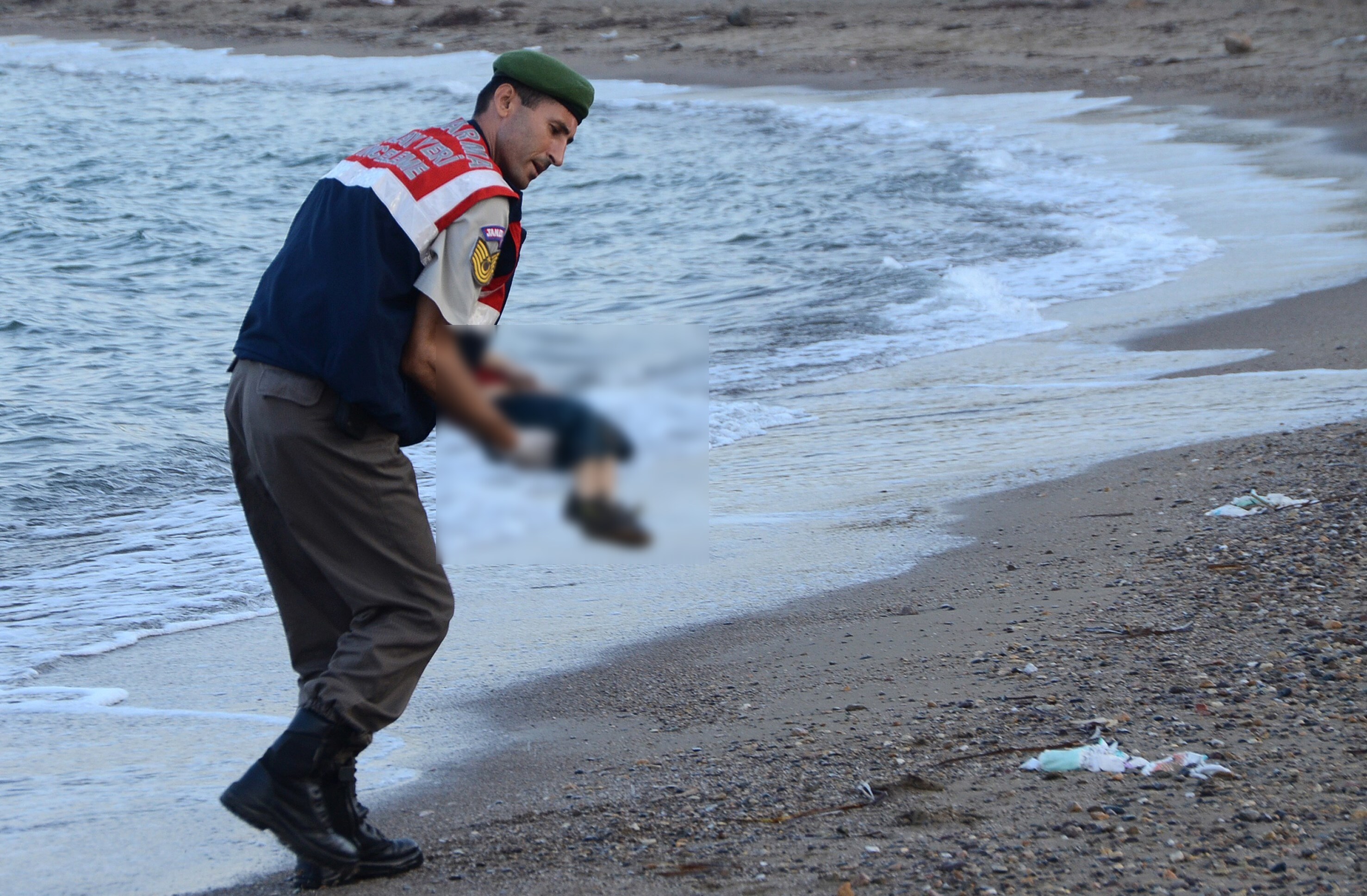
The children of divorced couples were cast out to sea. 3
Now they've drowned,
they're dead, while you were talking idly.
You were arguing, I don't know what about, and missed the headline crawling, cold and mean:
“The child
is dead!
He's drowned!
His heart
still remains
unseen.”
The children of divorced couples have no true home.
They have two houses,
two families,
two lives,
two selves within their own. 4
They can't say “my parents”,
They can't say “home” to their friends.
They just say I'm going here, I'm going there,
call their parents by name,
and must act as though it mends.
We called it Freedom,
Great Victory, our Mighty Prize. 5
Freedom to hurt,
but “we're the ones who civilize“!
The people were happy, didn't they cheer?
Meanwhile, you know what?
I'll start a new life, my dear.
I washed my hands, my conscience's clear. 6
Someone blames me?
They're just talking nonsense here.
The Romans treated children like rags to be thrown. 7
Jesus hugged them, drew them close to His own: 8
become like children,
listen to the pure,
love the small, the weak, the unsure.
For the least among you shall be the greatest above;
God will call their names, lift them up by His Love.
But what does Jesus know of our problems,
our tangled lives, so deep, so complicated?
He knows it all.
And He forgives it all.
There's no need to be agitated.
He forgives you all, dear parents. Every sin, each tiny piece. 9
But look upon that Cross sometimes,
look upon it when it rests in peace.
Look at His nails, His wounds,
the blood that still flows.
Bow to that Cross sometimes, dear parents,
you might just learn it all.
And say thanks, our Jesus, thank you.
Thank you, Jesus, and thank you once more.
The hour of the final thanks,
has come finally for all.
The poem is dedicated to all the childrens raised in divorced families. Jesus and His Holy Church will always be close to you and our prayers today are for you.
- Studies reveal that adults who grew up with divorced parents are statistically more exposed to situations of violence, both as perpetrators and as victims: for example, an increase in criminal violence and aggressive behaviours; victimization, low self-esteem and susceptibility to bullying; correlations between masochism in sexual practices, emotional abandonment, and childhood trauma. Other studies highlight the risk of normalizing divorce, which today is often seen as a useful “weapon” in married life —which on the contrary should be based on peace, not on war—: children of divorced couples learn from their parents, and as adults they are more reluctant to enter into marriage or to invest in long-term relationships. It is also becoming clear that divorce does not prevent violence, since separated women are even more at risk of violence from their ex-partners. The Catholic solution is to educate toward Peace and Respect within the couple, following the example of the Love of Jesus Christ (CCC), not to enter into union unless in an indissoluble way, to choose one's partner carefully, not to “test” them as one would test a car or try them out “for fun“.
- The references are to the accounts of the Crucifixion of Jesus the Savior in the Gospels: “But one of the soldiers pierced his side with a spear, and at once there came out blood and water. He who saw it has borne witness, his testimony is true, and he knows that he tells the truth, so that you may also believe.“ (John 19:34-35), “And behold, the curtain of the temple was torn in two from top to bottom; the earth shook, the rocks split.” (Matthew 27:51), ”It was now about noon, and darkness came over the whole land until three in the afternoon, for the sun's light failed.” (Luke 23:44-45).
- The sea, in the Bible and in tradition, has always been associated with chaos, difficulty, and death. For simple reasons: we cannot see clearly within it, we move with difficulty in it, and if we stay in it too long, we die. Yet at the same time, just as Baptism is both a symbol of death and rebirth, water is also a positive symbol of cleansing and regeneration. Woman, too, is linked to regenerative water, for she brings “newness” into families, children, just as migrants and foreigners can bring renewal to a nation, or new converts to the Church. The mere encounter with difference or opposition “cleanses” us, because it reveals our flaws and allows us to purify them. But take note: “newness” or “difference” —which may also be a new idea, not necessarily a person— can also harm us, invade us, or drive us crazy (“into exile”), like a medicine, a vaccine, or a serpent's venom given in excessive or too rapid a dose.Some examples of seas mentioned in the Bible —or lakes and rivers, a fixation that doesn't belong neither to us nor to the biblical authors: the sea in Genesis, inhabited by aquatic monsters (Genesis 1:21); Jonah in the belly of a fish for three days, prefiguring the Miracle of Jesus' Death and Resurrection (Matthew 12:40); Saint Peter, who manages to walk on water only through faith in and the help of Jesus (Matthew 14:28-31); Jesus sleeping during the storm at sea, then rebuking the winds, which fall silent at His command (Matthew 8:23-27); God turning the sea into dry land to let Moses pass through and free His people (Exodus 14:21-22).From tradition: the “human” odysseys of Ulysses and Aeneas, who, after overcoming monsters and storms, reach land and found civilizations; the vengeful Captain Ahab, who hunts down the enormous sea monster Moby Dick that in the past “paralyzed” him by devouring his leg; Pinocchio, who becomes an adult and human by saving his father, imprisoned inside a whale (or a shark); the little mermaid Ariel, “imprisoned” in the sea by her “tyrannical” father Poseidon, while yearning to reach Eric, the man she loves on the surface; Finding Nemo, where the return to the water becomes instead a critique of a hyper-technological and “male-centric“ world: the plan to return to the sea is thwarted by a new, ultra-modern aquarium filter, while Nemo himself is a small and “disabled” fish, a category that “belongs at the bottom” in a world centered around Power.Nemo is, in a sense, a continuation of The Little Mermaid, in a society that, having forgotten Jesus, no longer knows where the balance lies between inside and outside the water, between chaos and order. The balance known to Moses, taught by God, who could turn his staff into a serpent and back again, as needed and with mastery (Exodus 4:1-5). The ultimate Christian solution? Order becomes chaos in order to save chaos and bring it to the surface (Incarnation, Death, and Resurrection of Jesus, the Assumption of Mary).We find similar elements in the “Christian” The Little Mermaid: Ariel, a “hybrid” and rebellious creature —passionate, instinctive, and red-haired, like Esau, the well-known figure from Genesis— first tries to reach the surface on her own, but this only provokes the anger of her father, Poseidon; he unleashes a storm, Eric is caught in it, Ariel saves him and brings him back to the surface, she “cleanses” him, just as the “storms” of life can regenerate us, if we do not drown in them: it is in this moment that Arial falls in love with the ”pure” prince. After her first attempt at revolution fails, Ariel does not give up and tries again, this time with the help of the deceitful witch Ursula, but at the cost of losing her voice, her femininity, the very thing that had made Eric fall in love with her: she ends up a prisoner of the witch. In the end, it is Eric who saves Ariel, who has sunk to the bottom of a sea whirlpool, by defeating Ursula in the final battle, who in the meanwhile has transformed into a gigantic sea monster with tentacles and a masculine voice: here she “bites her own tail”, because after her social climb to the surface, Eric can now easily confront her with his armed ship and defeat her. A story that melts the heart, even Poseidon's, who eventually changes his mind and accepts the marriage.
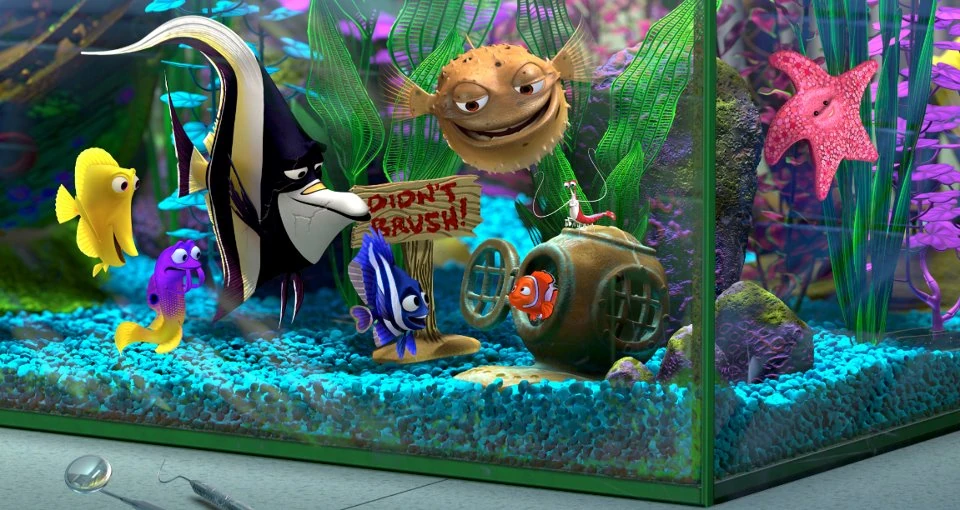

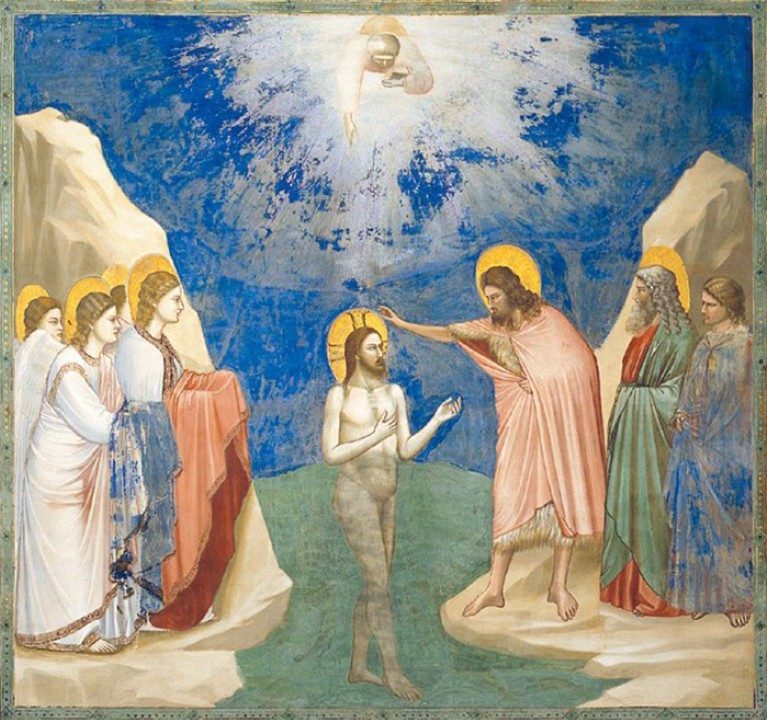
Below: the rebellious Little Mermaid who wants to come out of the water —here in her modern version, where the mermaid is by necessity an ethnic minority “struggling” to reach the surface; above: the little fish Nemo, now “imprisoned” on the surface, a “fish out of water” who instead longs to return to the sea. Sad below, sad above, never finding peace. The solution, to the side: Giotto's Baptism of Christ. In this brilliant and beautiful depiction (not uniquelink1,link2), preserved in the Scrovegni Chapel in Padua, Jesus is at the same time both inside and outside the water, as He receives the Holy Spirit from the Father, here unusually depicted as visible and holding the Word in His hands. The reference is to the Incarnation —Jesus being at the same time God and man— and to the indissoluble and harmonious union of His two natures. In the same way, during the Holy Mass, the divine wine is mingled with a drop of earthly water, and the whole is then lifted up to God. The story also echoes a Greek myth of Hercules, who fights a sea monster to free the princess Hesione (with somewhat uncertain outcomes in the end), or its “Christianized” Disney version, where Hercules descends into the Underworld, rises again, and frees Megara, who had died and been imprisoned by Hades.In the real world, it was God Himself who resolved the problem, the one that men have struggled over without solution since ever: He made myth into history (“a true myth,” as C.S. Lewis would saylink), by sending His Only Son, who became man, died, rose again, and saved us all, out of Love. We give eternal thanks to God for this reason. - On the impact of lacking the stability and unity of a single home: a video interview with an “adult” child Rachel Oline, who grew up with divorced parents and is now a member of Life-Giving Woundslink, a ministry dedicated to the pastoral care and support of Catholics with separated or divorced parents.
- In Italy, divorce was saved by a referendum in May 1974 with the support of 60% of voters. Some headlines of the timesource, which still echo today on the lips of many, despite thedisasters of that choice: “Great victory for freedom“, L'Unità; “Italy is a modern country. Divorce remains“, La Stampa; “Victory of reason“, Paese Sera; “A landslide of no votes“ L'Avanti.This, instead, was the tone, as usual prophetic, of the Catholic Church, which already knew everything more than 100 years earlier: “Matrimonial contracts are by [divorce] made variable; mutual kindness is weakened; deplorable inducements to unfaithfulness are supplied; harm is done to the education and training of children; occasion is afforded for the breaking up of homes; the seeds of dissension are sown among families; the dignity of womanhood is lessened and brought low, and women run the risk of being deserted after having ministered to the pleasures of men. [...] With such incitements it must needs follow that the eagerness for divorce, daily spreading by devious ways, will seize upon the minds of many like a virulent contagious disease, or like a flood of water bursting through every barrier.“, Pope Leo XIII, Arcanum Divinae Sapientiae, February 1880.In Italy today, divorces have now reached the number of marriages, the number of people living alone is at a record high, infidelity causes almost half of divorces, in 92% of divorce cases children are involved, the birth rate is at an all-time low (Istat). We wanted “freedom“, here it is served the prison of loneliness.
- The reference is to Pontius Pilate, who believes he can wash his hands, and his conscience, of Jesus' crucifixion simply because his decision was loudly acclaimed by the people: “Pilate saw that he wasn't getting anywhere and that a riot was developing. So he sent for a bowl of water and washed his hands before the crowd, saying, “I am innocent of this man's blood. The responsibility is yours!” (Matther 27:24).
- To understand how the ancient Romans viewed children, here are some testimonies about the exposure of infants (expositiolink, literally “to leave without shelter”), a practice unfortunately very widespread in Roman times: a “love” letterlink between a Roman soldier and his wife, in which he suggests the “abortion” of already-born children in the “unfortunate” case that they should be female; Cicero, in De Legibus 3.8.19, reaffirms the legal obligation to “quickly kill infants born deformed”; Seneca, in De Ira 1.15.C, clearly summarizes the philosophy of the time: “We put down raging dogs, [...] we suffocate monstrous fetuses, and even our own children, if they are born weak or abnormal, we drown them; but this is not anger, it is reason, to separate the useless from the healthy.”Things were no better in Greece: Aristotle, in Politica 7.1335b, writes that “by law, it is good that those born deformed be put to death”. It was only in A.D. 374 that Roman law finally recognized the homicide of a child as homicide: a full 37 years after the abolition of the “barbaric” (in truth, very-“Roman“) practice of crucifixion, by order of Constantine.
- Passages on Jesus' love for children and on their centrality, also as an example for our role as believers: “People were bringing little children to Jesus for him to place his hands on them, but the disciples rebuked them. When Jesus saw this, he was indignant. He said to them, «Let the little children come to me, and do not hinder them, for the kingdom of God belongs to such as these. Truly I tell you, anyone who will not receive the kingdom of God like a little child will never enter it». And he took the children in his arms, placed his hands above them and blessed them.“ (Mark 10:13-16), here, God's love for children is so countercultural that even Jesus' own Jewish disciples initially try to keep them away from Him, to avoid mixing the first with the last; “At that time the disciples came to Jesus and asked, “Who, then, is the greatest in the Kingdom of Heaven?” He called a little child to him, and placed the child in the midst of them. And he said: «Truly I tell you, unless you change and become like little children, you will never enter the Kingdom of Heaven. Therefore, whoever takes the lowly position of this child is the greatest in the Kingdom of Heaven. And whoever welcomes one child like this in My name, welcomes Me.».“ (Matthew 18:1-5).
- The Christian God does not reveal Himself through punishments and sacrifices, but through mercy; He is not a God of fear, but of Love: “For God so loved the world that He gave His only Son [...] not to condemn the world, but that the world might be saved through Him.” (John 3:16-17), “I desire mercy, not sacrifice. For I have not come to call the righteous, but sinners” said Jesus in Matthew 9:13, quoting Hosea 6:6: “For I desire mercy, not sacrifice, the knowledge of God rather than holocausts.”. Saint Augustine wrote: “God is just, but He is even more merciful” (Commentary on Psalm 118, Sermon 33), summarizing many similar comments by other Doctors of the Church (Saint Thomas Aquinas, Saint Thérèse of Lisieux, Saint John Paul II, etc.). On the importance of the act of contrition for the forgiveness of sins: CCC 1451-1454.
